
 English
 Tiếng Việt
Sales Software Design: Choosing the Right "Weapon" to Win the E-commerce Race
1. Great Apps Are Not Born, They Are "Built" on Technology Foundations
Many businesses, when approaching us, often start with questions about appearance: "What color is the App?", "Where is the buy button placed?", "Is the scrolling effect smooth?". Very few ask the most important question: "What language is this App written in and on what platform does it run?".
In 15 years of practice, I have witnessed many projects fail not because of bad ideas, but because of choosing the wrong Tech Stack. It's like trying to build a skyscraper on sand. Initially, it might be fine, but as the number of users increases, the App starts to lag, gets buggy, and the cost to upgrade or maintain becomes enormous.
At TheApp4U, we don't just "make Apps", we "technologize" your business ideas using international standard technologies.
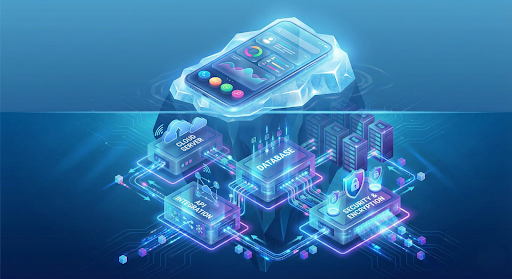
2. Frontend Layer (Interface): The Battle Between Flutter & React Native
Why do we advise Cross-platform solutions instead of Native (Separate code for iOS and Android)? The answer lies in the problem of economics and speed.
Instead of maintaining 2 coding teams (1 team doing Swift for iOS, 1 team doing Kotlin for Android), we use the most powerful Frameworks available today to "Write once, run everywhere":
- React Native (Developed by Facebook): This is the technology behind the Facebook, Instagram, or Airbnb apps themselves. Its power lies in a huge community and the Hot Reloading feature that allows us to update the App interface instantly without forcing users to re-download the update from the Store.
- Flutter (Developed by Google): The new "darling" of the tech world. The absolute advantage of Flutter is performance approaching 60fps (frames per second) like a native App. Flutter redraws every pixel on the screen, helping the interface display absolutely consistently whether the customer uses an iPhone 15 or a cheap Android phone.
Benefit for businesses: Save 40-50% of development costs and shorten time-to-market by half.

3. Design Layer: Not Just Drawing, But Systems Thinking (Design System)
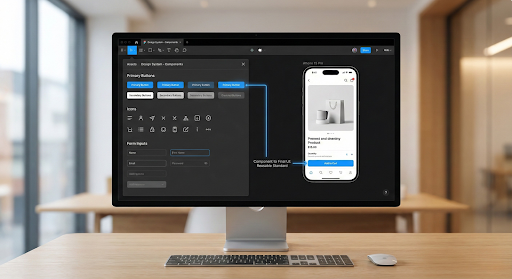
The tool we use is Figma, but what makes the difference is Design System thinking.
We do not draw screens spontaneously. We build a standard library (Component Library): Buttons, brand colors, fonts, spacing... are all defined like LEGO pieces.
Why is this important for your wallet? Imagine after 6 months, you want to change the brand color from Green to Red for the Tet event.
- Old way: Designer has to open 50 App screens to fix bit by bit. Takes 1 week.
- TheApp4U's way: We just need to change the color code in the Design System, all 50 screens update automatically in 1 minute. Consistency helps the App look professional and easy to maintain.
4. Backend & Cloud Layer: The "Brain" Processing Thousands of Orders
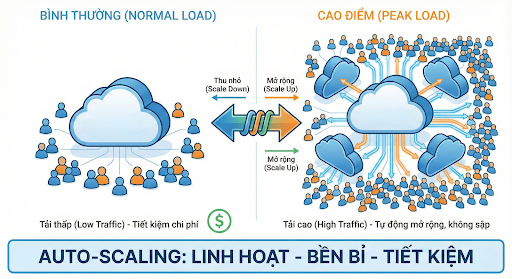
A Sales App, no matter how beautiful, is useless if it "crashes" as soon as you run a Livestream ad. We use cloud computing infrastructure from AWS (Amazon Web Services) or Google Cloud with Auto-scaling mechanism.
Imagine the server as checkout counters in a supermarket:
- Normal days (100 customers): The system runs only 1 server (maximizes operating cost savings).
- Black Friday/Flash Sale (10,000 customers): The system automatically detects a sudden traffic spike and "clones" to 10, even 50 servers instantly to process orders.
- Event ends: The system automatically turns off excess servers, returning to a saving state.
You never have to pay for unused resources, but never have to worry about "site crashes" due to overload.
5. Analytics Layer: Understanding Users Through Every Touch
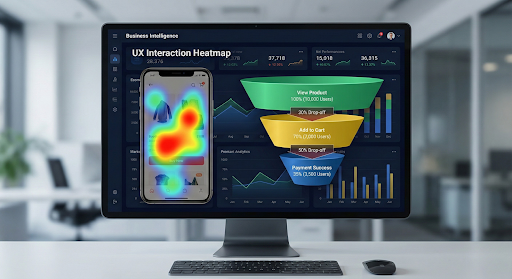
We don't just hand over the App and be done with it. We integrate Google Analytics for Firebase deep into every event (Event tracking).
It doesn't just count downloads. It answers vital questions for you:
- At which step do customers usually Drop-off? (Why did they add to cart but not pay?)
- Which features are used the most, which are ignored?
This data is "pure gold" for your Marketing and Sales team to optimize Conversion Rate after the App is operational.
6. Integration & Security Layer: The Smart "Safe"
A sales App cannot stand alone. It needs to "talk" to external systems and be absolutely secure.
- Payment & Shipping Ecosystem (3rd Party Integration): Instead of letting customers transfer manually and take screenshots, TheApp4U integrates popular Payment Gateways like Momo, ZaloPay, VNPay, OnePay. At the same time, the App automatically connects APIs with shipping units (GHN, GHTK) to calculate shipping fees in real-time.
- Multi-layer Security: Customer data is the most valuable asset. We apply SSL/TLS encryption standards for transmission lines and comply with payment security principles. Hackers cannot "eavesdrop" on your customers' card information or phone numbers. The App is designed to be "immune" to basic DDOS attacks.
7. Don't Let "Technical Debt" Hinder Revenue
Choosing the wrong technology today is like taking a "hot loan". At first, you see it as cheap and fast, but the interest to pay later is very expensive: slow App, difficult to upgrade, poor security, and customers leaving.
TheApp4U does not race for cheap prices. We race for Architectural Quality.
We build applications capable of handling millions of users, ready to Scale-up whenever your business explodes in sales.
Don't bet your business future on makeshift lines of code. Build a solid foundation starting today.
Do you want to know what technology your App needs?
Add New Comment